How to Calculate the Weight of an MS Angle: A Step-by-Step Guide
When working with structural steel, specifically Mild Steel (MS) angles, knowing the exact weight per meter is crucial. Whether you are estimating costs for a fabrication project, calculating transportation loads, or ensuring structural integrity, precision matters.
While many engineers rely on standard weight charts, understanding the underlying calculation is essential for quality checks and custom dimensions. Recently, we looked at a practical example of an MS Angle measuring 50 x 50 mm x 6 mm with a length of 1 meter. Let’s break down how the weight was calculated using basic geometry and density principles.
Understanding the Geometry
An MS Angle (L-shaped profile) is not a simple rectangular block. To calculate its volume, we visualize it as two separate rectangular plates joined together.
In our example, the angle has equal legs of 50 mm each and a thickness of 6 mm. However, when calculating the volume of the two sides, we must be careful not to double-count the overlapping section at the corner.
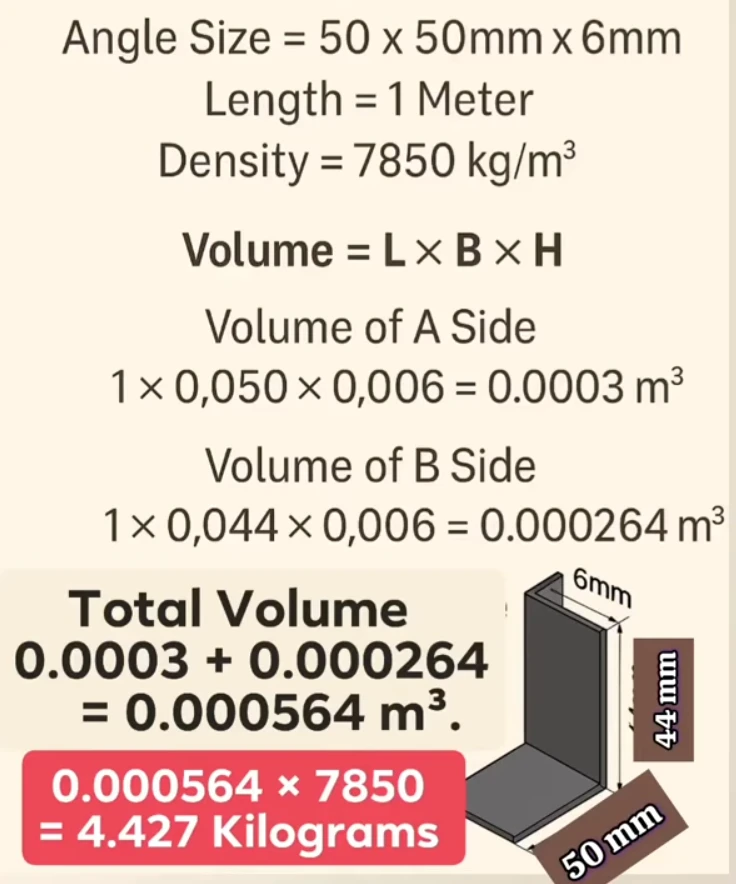
Here is the standard approach used in the image:
-
The “A” Side: This is the full leg.
1 m×0.050 m×0.006 m=0.0003 m3 -
The “B” Side: Since the corner where the two legs meet was already accounted for in the “A” side, we deduct the thickness from the length of the second leg.
The calculation uses 50 mm−6 mm=44 mm (or 0.044 m).
1 m×0.044 m×0.006 m=0.000264 m3
Calculating the Volume and Weight
Once the individual volumes are established, we sum them to get the total volume of steel in one meter of the angle.
Total Volume
0.0003+0.000264=0.000564 m3
Now, we apply the density of mild steel. The standard density used in the industry is 7,850 kg/m^³ (or 7.85 g/cm^³). Multiplying the volume by the density gives us the mass.
Weight Calculation
0.000564 m^3×7850 kg/m^3=4.427 Kilograms
Thus, a 1-meter length of a 50x50x6 mm MS Angle weighs approximately 4.43 kg.
Why This Method Matters
You might wonder why we don’t simply calculate the cross-sectional area of the “L” shape and multiply it by the length. In essence, that is exactly what we did—but by splitting the shape into two rectangles, we avoid the mathematical error of counting the corner square twice.
If you were to calculate the area as (50×6)+(44×6), you get the same result: 300+264=564 mm2. Converting that to meters squared and multiplying by the length and density yields the same weight.
Practical Formula
For any equal-leg MS angle, you can use this simplified formula to find the weight per meter:
Weight (kg/m)=[(2×W−t)×t]×Density×Length
Where:
-
W = Width of the leg (in meters)
-
t = Thickness (in meters)
For our example:
(2×0.05−0.006)×0.006=0.000564 m2 (area)
0.000564×7850=4.427 kg/m
Understanding the weight calculation of an MS angle ensures that you can verify supplier deliveries, optimize material usage, and maintain safety standards. The method shown above—breaking the angle into two rectangles to find the volume—is a reliable way to get accurate results without relying solely on pre-printed charts.
Whether you are a civil engineer, a fabricator, or a DIY enthusiast, mastering this simple calculation will help you manage your steel requirements with confidence.
“Thank you for reading! If you found this article insightful and valuable, consider sharing it with your friends and followers on social media. Your share can help others discover this content too. Let’s spread knowledge together. Your support is greatly appreciated!”
