For decades, engineering has been a discipline of handoffs. The design team creates a model , technical drawing and passes it to manufacturing, who interprets it and creates a process plan, who then hands it off to quality assurance, and finally to service. Each handoff represents a fracture in the data continuum—a point where information is lost, misinterpreted, or simply forgotten. CAD, CAE, and CAM tools were built by different vendors, at different times, each piece of optimizing for their own phase of the workflow. Interoperability was never the design goal, and the cost of that shows up at the boundaries, where engineers spend hours manually moving data between systems that were never meant to talk to each other.
This fragmentation is not accidental it is result of close ecosystem of proprietary software companies to lock the user in their eco system. Manufacturing software vendors have historically maintained closed ecosystems as a deliberate competitive strategy. By locking customers into a proprietary slicer, a specific file format, release new version every year to lock previous version file and force end user to extend license and a native API, they create high switching costs — making churn unlikely.
This is the hard reality of proprietary CAD tools: once you’re locked into an ecosystem, it’s difficult to leave. Data silos were not a side effect; they were structurally baked in. The cumulative effect across the industry is a software landscape that has become architecturally sequential. Each phase of the engineering process now relies on a specialised tool from a different vendor, and there is little incentive for these vendors to ensure their products communicate cleanly with others.
Aibuild OS is the latest and most ambitious attempt to solve this structural problem. Launched in Public Alpha in March 2026, the platform represents a strategic evolution for the London-based firm, which built its reputation on vertical-specific CAM software used by companies such as Ford and Boeing.
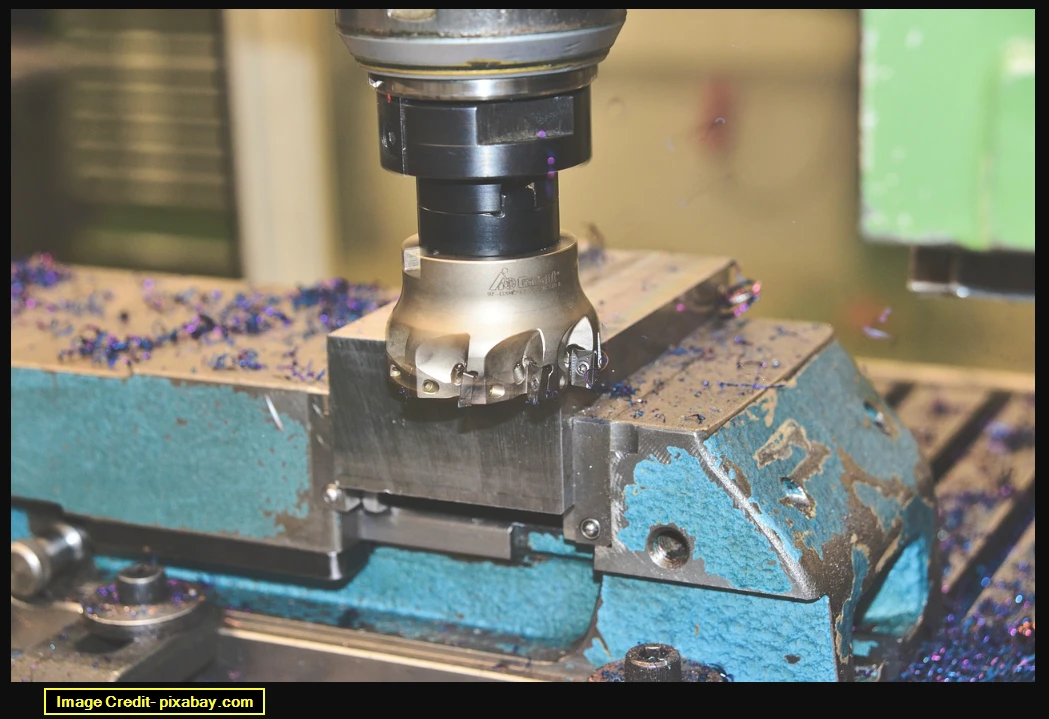
General CAM programs such as Mastercam handle basic milling and turning for many different parts. Vertical-specific software goes deeper into one trade. It includes pre-set tool libraries, specialized calculations, and automated steps for that exact field.
- Targeted Tools: The software speaks the language of your specific trade.
- Faster Setup: Built-in templates reduce the time needed to program a job.
- Error Reduction: Industry-specific safety checks prevent costly crashes on complex parts.
With Aibuild OS, the company is shifting toward a broader horizontal platform—one that applies manufacturing intelligence across the entire engineering life cycle rather than a single phase of it.
The Problem: Structural Fragmentation-:
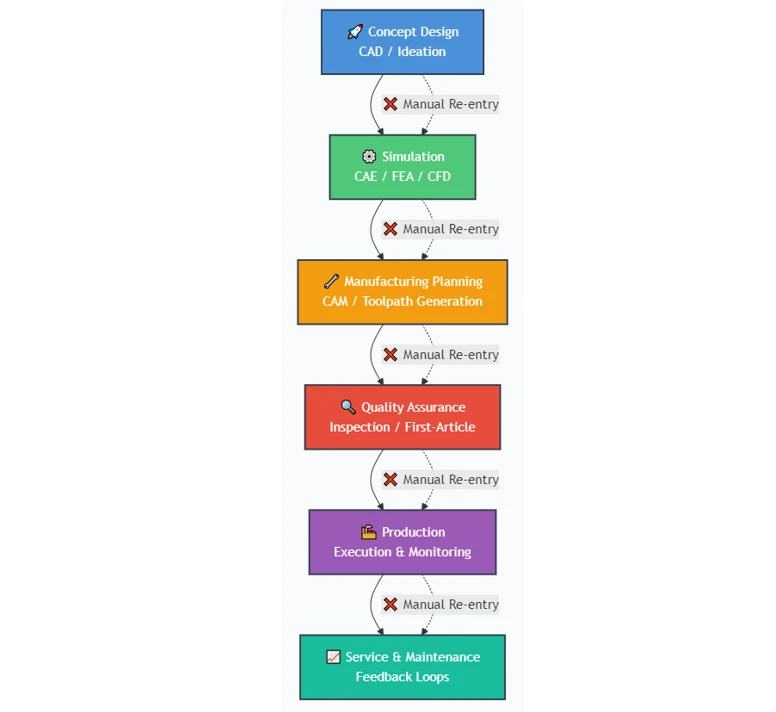
Before assessing whether AI can automate end-to-end engineering, we must understand what “end-to-end” actually means in this context. A typical engineering workflow involves dozens of discrete steps which are as follow:
- Concept Design: Ideation and initial geometry creation in CAD
- Simulation: Finite element analysis (FEA) and computational fluid dynamics (CFD) in CAE
- Manufacturing Planning: Process definition in CAM, including tool path generation
- Quality Assurance: Inspection planning and first-article inspection
- Production: Execution and monitoring on the shop floor
- Service and Maintenance: Feedback loops for product improvement
In the traditional model, data moves between these stages through a linear, rigid process based on export and import operations. Each transition introduces opportunities for error, data loss, and delay. A design change in CAD doesn’t automatically update the simulation model; a simulation result doesn’t automatically inform the manufacturing plan; a production issue doesn’t automatically feed back to design.
The impact is measurable and significant. Engineers spend hours moving data between disconnected tools and manually translating outputs. This “human execution bandwidth” becomes the primary bottleneck, limiting engineering capacity and slowing innovation.
Also Read-:
- Open-Source CAD Software for Linux Operating System
- EXModel Streamlines the CAD Process from 3D Scanning to Manufacturing
- Basic Guide to Autodesk Inventor and How Does It Work?
The Aibuild OS Solution: Digital Engineers-:
At the core of Aibuild OS are what the company calls “Digital Engineers”—autonomous AI agents capable of executing multi-step workflows across different software environments without requiring constant human oversight.
These are not the assistive copilots we’ve seen in other industries. Unlike traditional assistance functions that require constant human supervision, Digital Engineers are agentic AI systems that can plan and execute complex processes independently. They don’t just analyze data; they translate it between different software environments and directly initiate process steps.
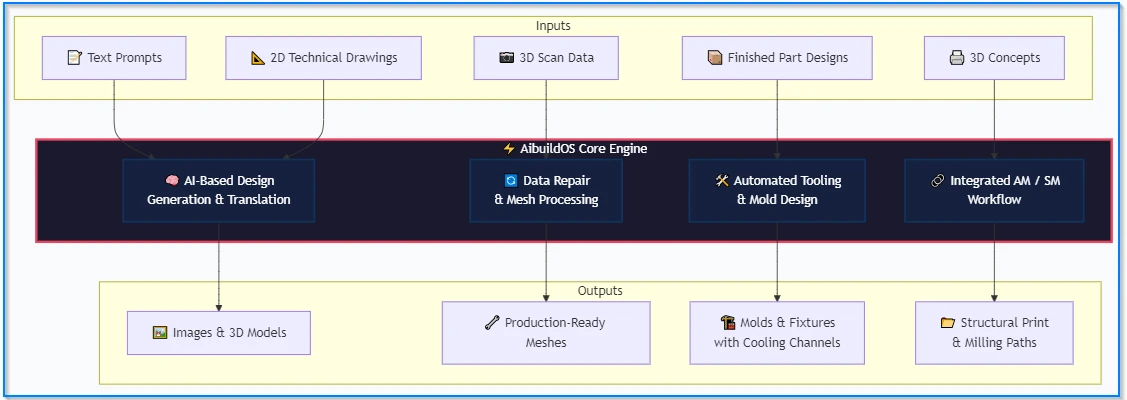
“In practice, that means tasks like converting raw 3D scan data into production-ready meshes, generating molds and fixtures directly from finished part designs, or taking a 3D concept all the way to a structural print and milling path without manual cleanup at each hand-off”.
The platform is designed to solve several specific industrial engineering challenges:
- Concept Design and Generation: Bridging the gap between creative intent and engineering data. Aibuild OS can transform text prompts into images, convert 2D technical drawings into 3D models, and use Image-to-3D workflows to speed up early-stage design.
- Data Repair and Processing: Converting raw 3D scan data into clean, production-ready meshes, removing the need for hours of manual geometry repair.
- Rapid Tooling and Mold Design: Processing finished part designs to automatically generate molds and fixtures featuring complex cooling channels and optimized design for manufacturability.
- Integrated Additive and Subtractive Manufacturing: Transitioning from a 3D concept to a structural print and milling path without manual geometry cleanup or slicing adjustments.
Daghan Cam, Co-Founder and CEO of Aibuild, frames the mission in stark terms: “For too long, engineering capacity has been limited by human execution bandwidth. We are removing these barriers. By allowing engineers to deploy autonomous AI directly into their workflows, we help teams solve complex production challenges, reduce lead times, and increase productivity”.
Also Read-:
- How AI in CAD Market Transforming Growth
- Beginner Guide to Computer Aided Design
- Best Mechanical Design Software 2026
The Human-in-the-Loop Reality-:
A critical question emerges: If Digital Engineers can automate multi-step workflows, does this replace human engineers? The answer, according to current research and industry practice, is more nuanced.
Recent academic work on “Agentic Smart Design” frames the relationship as a human-AI collaborative paradigm where autonomous intelligent agents actively participate as co-creators. In this model, “the human designer often acts as a strategic director, setting high-level constraints and aesthetic intentions, while the agentic system autonomously explores vast permutation spaces to generate, test, and rank viable alternatives”.
This aligns with the vision for Aibuild OS. The platform is designed to reduce the cognitive load on human engineers, allowing them to focus on strategic decisions and validation rather than repetitive data conversion operations. The shift is from tool operation to engineering judgment—from spending hours on data translation to making decisions about which trade-offs best fit the application.
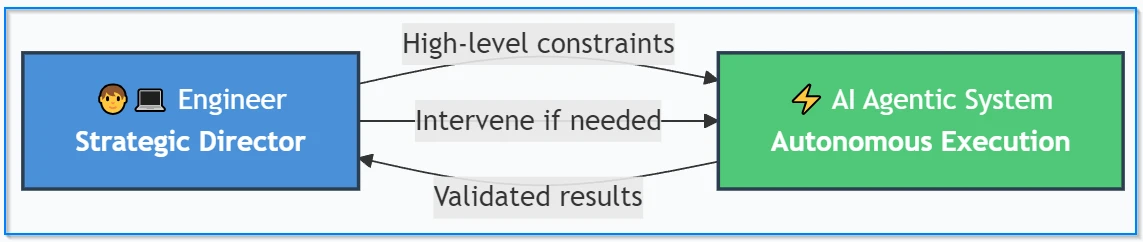
Cognitive Design Systems (CDS) demonstrated a similar paradigm in March 2026, connecting an on-premises MCP server to Anthropic’s Claude LLM to create a fully autonomous part optimization workflow. In their demonstration, an engineer directs the system to a CAD file and specifies load cases and constraints, and the system runs a closed optimization loop—generative design, meshing, FEA, stress evaluation, manufacturing-driven design, geometry refinement—autonomously. The engineer decides how much to intervene: the system can run end-to-end without interruption, or the engineer can engage at any stage.
The key insight from both Aibuild and CDS is that these systems don’t eliminate the engineer; they eliminate the execution bottleneck. As Rhushik, CEO of Cognitive Design Systems, puts it: “Engineers have always known what great design looks like. The bottleneck has never been judgment; it has been execution time. This removes the bottleneck, while keeping the engineer in the loop at every step”.
Also Read-:
- Beginner Guide to Computer Aided Design
- Open-Source CAD Software for Linux Operating System
- EXModel Streamlines the CAD Process from 3D Scanning to Manufacturing
A Shift from Vertical to Horizontal-:
Aibuild OS represents a deliberate strategic shift for the company. Aibuild built its reputation on vertical-specific software with Aibuild CAM. OS represents a move toward a broader horizontal platform.
This horizontal approach is crucial because the fragmentation problem Aibuild OS is designed to solve spans multiple domains. Engineers don’t just need better CAM or better CAD; they need a system that can orchestrate all these tools as a single intelligent system.
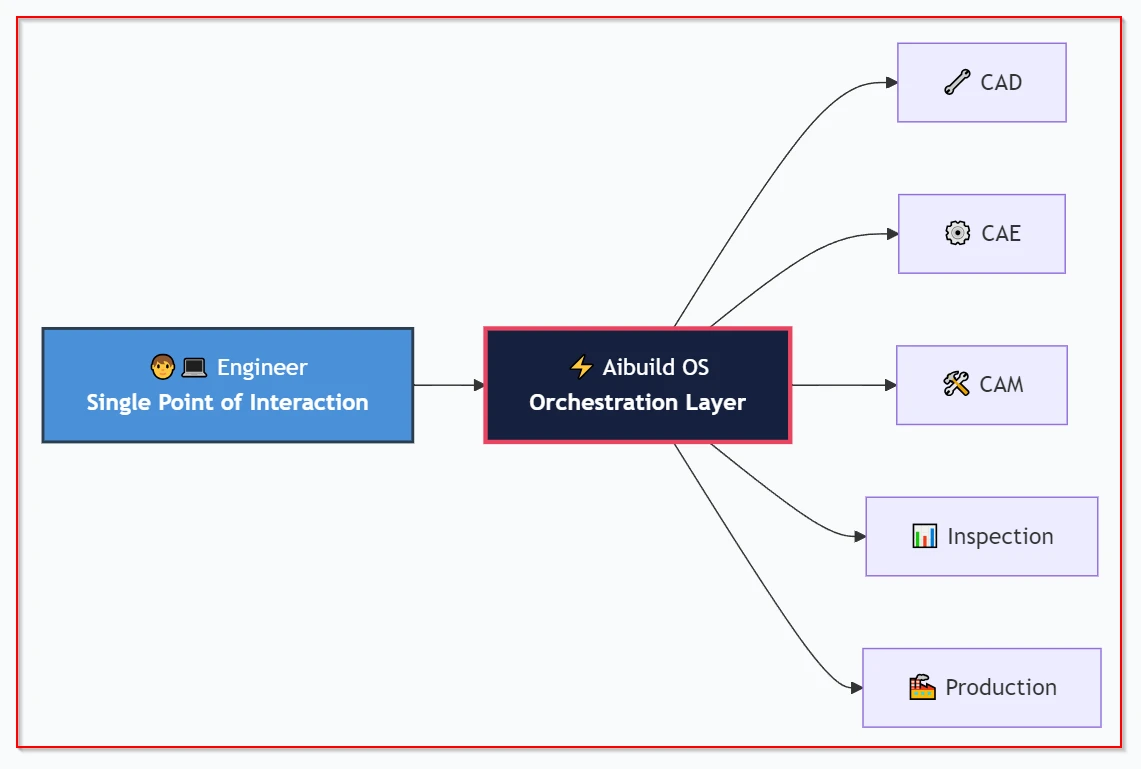
As Michail Desyllas, Co-Founder and COO of Aibuild, states: “Traditional manufacturing software creates silos. Engineers spend hours moving data between disconnected tools and manually translating outputs. Aibuild OS orchestrates these processes as a single intelligent system. It is the operating system layer that manufacturing has lacked until now”.
Also Read-:
- Open-Source CAD Software for Linux Operating System
- FreeCAD Integration with KiCAD
- How AI in CAD Market Transforming Growth
The Infrastructure Challenge: Data, Security, and Standards-:
Despite the promise, significant challenges remain. A recent academic analysis of agentic workflows in smart manufacturing highlights a fundamental dilemma: these systems must balance structure and traceability with adaptability and innovation. Safety-critical industrial settings require oversight, traceability, and accountability, but fully autonomous systems can lack the necessary structure.
The solution, the paper argues, is an “agentic workflow” that embeds intelligent agents within a structured and explicit process graph, hitting a sweet spot for smart manufacturing by balancing autonomy and control.
Another critical concern is data security. Most AI tools for engineering require sending design data to a cloud server. For companies working on defense programs, space hardware, or proprietary automotive platforms, that is not an option. ITAR, EAR, and equivalent regulations make cloud-routed design data a compliance problem. CDS addresses this with an on-premises MCP Server, ensuring that CAD files, simulation results, and design logic never leave the customer’s network. It remains to be seen how Aibuild OS handles this requirement during its Public Alpha phase.

The geometry representation problem also persists. AI-generated designs often depend on facet representation, with precision limited by mesh resolution. Manufacturing-ready designs, however, require the exact boundary representation (B-rep) used by most CAD systems. This allows engineers to accurately edit parametric designs and easily export them to downstream software. InfinitForm, another AI engineering startup, addressed this by integrating Siemens’ Parasolid kernel to generate prismatic models with embedded manufacturability constraints that are fully editable in any CAD system . Aibuild OS will need to demonstrate similar rigor in generating geometry that is truly manufacturing-ready.
Also Read-:
- Beginner Guide to Computer Aided Design
- Best Mechanical Design Software 2025
- How AI in CAD Market Transforming Growth
The Verdict: Automation as Orchestration-:
So, will AI automate end-to-end engineering? The answer appears to be yes, but not in the way many might imagine. This is not about replacing human engineers with algorithms. It is about eliminating the “human execution bandwidth” bottleneck that has constrained engineering capacity for decades.
Aibuild OS, alongside similar initiatives like CDS’s autonomous optimization workflow and InfinitForm’s AI design assistant, represents a shift from tools that assist to systems that orchestrate. These platforms maintain an explicit process graph while enabling selected nodes to be executed by intelligent agents or humans when oversight is required, offering a structured yet adaptive solution .
The numbers speak to the potential impact. Where a typical development cycle yields 3 to 5 explored concepts before timeline pressure forces a decision, CDS’s workflow produces 50+ fully analyzed variants in the same period. InfinitForm reports design cycles improved by up to 70%, with the potential of bringing new products to market faster and cheaper.
The challenge now is execution. Aibuild OS is in Public Alpha. As the Aerospace Industries Association (AIA) and EY US found in their recent report, while three-quarters of aerospace and defense organizations are implementing Digital Thread capabilities in some capacity, only 14 percent say it is fully applied across the enterprise . The gap between technology availability and enterprise adoption remains vast.
For future engineers and the companies that employ them, the message is clear: the era of manual data translation and sequential tool operation is ending. AI-driven orchestration platforms like Aibuild OS are not the future—they are arriving now. The question is not whether end-to-end engineering automation will happen, but which organizations will master it first and which will be left behind in an increasingly complex and data-driven world.
“Thank you for reading! If you found this article insightful and valuable, consider sharing it with your friends and followers on social media. Your share can help others discover this content too. Let’s spread knowledge together. Your support is greatly appreciated!”